
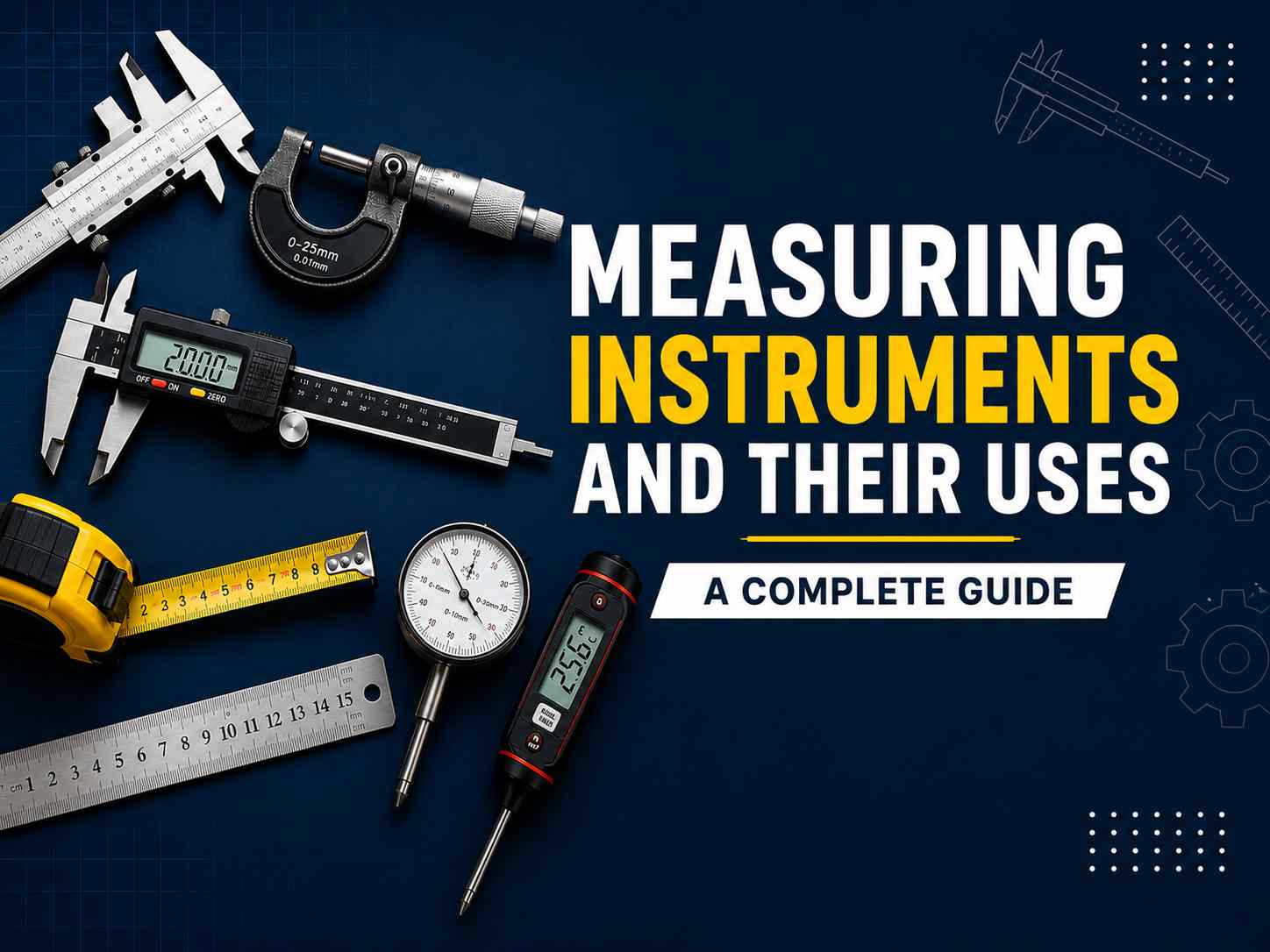
List of Measuring Instruments and Their Uses

Whether you're operating a CNC machine, handling quality checks in a lab, or running a precision workshop, choosing the right measuring tool is critical. Even a small error can lead to rejected parts and unnecessary costs.
In this guide, we’ll walk through the key measuring instruments used in engineering and manufacturing explaining what they are, how they function, and where they’re commonly applied.
If you are looking for reliable measuring tools for your workshop, BlocktoBox stocks a wide range of precision instruments from trusted brands like insize, Mitutoyo, Baker, and Luthra all available for delivery across India.
What Are Measuring Instruments?
Measuring instruments are tools or devices used to determine the physical dimensions, properties, or characteristics of an object such as length, diameter, height, depth, angle, thickness, or surface flatness. In precision engineering and manufacturing, accurate measurement is the backbone of quality control, and selecting the right instrument for each task is critical.
Let us Dive into the each Measuring tools
1. Vernier Calipers
What it measures: External dimensions, internal dimensions, depth, and step height
A vernier caliper is a tool you’ll find in almost every workshop because of how versatile it is. It can measure the outside of an object, the inside of a hole, and even the depth of a slot using its different parts. The outer and inner jaws handle the measurements, while the depth rod comes in handy for deeper sections. With its vernier scale, it also offers pretty fine accuracy, usually up to 0.02 mm.
Types available
-
Standard Vernier Calipers — Manual reading with a vernier scale
e.g., Insize 1205 Series -
Digital Vernier Calipers — Digital display for fast, error-free reading
e.g., Insize 1108 Series, Mitutoyo 500 Series -
Dial Calipers — Analog dial display for easy reading
e.g., Mitutoyo 505 Series -
Depth Verniers — Designed specifically for measuring slot and hole depths e.g., Insize 1240 Series
-
Long Range Digital Calipers — For larger workpieces up to 1000 mm
e.g., Insize 1106 Series
Common uses
-
Checking shaft diameters on turned components
-
Measuring bore inner diameters
-
Inspecting step heights on machined parts
-
Quality control in production environments
Industries: Automotive, aerospace, tool rooms, general engineering, fabrication
2. Micrometers
What it measures: Outside diameters, inside diameters, with accuracy up to 0.001 mm
A micrometer uses a calibrated screw mechanism to achieve far greater precision than a caliper. The spindle advances by 0.5 mm per revolution, and the thimble scale further divides this into 0.01 mm or 0.001 mm increments depending on the type.
Types available
-
Outside Micrometers (OD) — For measuring external dimensions
e.g., Insize OD Micrometers, Mitutoyo Outside Micrometers -
Digital Outside Micrometers — With digital display for instant reading
e.g., Insize Digital OD Micrometer, Mitutoyo Digimatic Outside Micrometer -
Inside Micrometers (ID) — For measuring internal bores and slots
Common uses:
-
Measuring precision shaft tolerances after grinding
-
Checking wall thickness of tubes or components
-
Inspecting the diameter of turned parts to micron-level accuracy
Industries: Precision machining, die and mould making, aerospace, automotive
3. Height Gauges
What it measures: Vertical measurements taken relative to a reference surface plate.
A height gauge is used on a surface plate to measure the height of features on a workpiece, or to scribe layout lines at precise heights. It stands upright with a measuring jaw or scriber that moves along a vertical column.
Types available
-
Digital Height Gauges — With driving wheel for smooth movement
(e.g., Insize 1156 Series — available in 300 mm, 600 mm, and 1000 mm ranges) -
Vernier Height Gauges — Manual scale reading
(e.g., Insize 1250 Series)
Common uses:
-
Measuring component height relative to a datum
-
Scribing accurate layout lines for machining
-
Checking parallelism between two surfaces
-
Inspection of castings and fabricated parts
Industries: Toolmaking, inspection labs, precision machining, quality assurance
4. Bore Gauges
What it measures: Internal diameters of holes, cylinders, and bores
A bore gauge measures the inside diameter of a hole by expanding its contact points to touch the bore wall. It is typically used in combination with a dial indicator for the actual reading.
Types available
-
Dial Bore Gauges — The most common type, featuring a dial indicator for readout (e.g., Insize Bore Gage with Dial Indicator, 18–450 mm range)
Common uses:
-
Measuring cylinder bore diameters in engine manufacturing
-
Checking hole tolerances after drilling and reaming
-
Verifying the internal diameter of bushings and bearing housings
Industries: Automotive, heavy engineering, hydraulics, pump manufacturing
5. Dial Indicators
What it measures: Small variations in surface position or displacement runout, alignment, flatness
A dial indicator also called a dial gauge converts small linear movement of its contact point into a rotary motion displayed on a circular dial. It is mounted on a magnetic stand or fixture for hands-free operation.
Types available
-
Plunger Type Dial Indicators — Standard front-plunger design (e.g., Mitutoyo Plunger Type Dial Gauge)
-
Basic Type Dial Indicators — Cost-effective for general use (e.g., Insize 2301 Series)
Common uses:
-
Checking runout on shafts and spindles
-
Setting up workpieces accurately in machine vices
-
Measuring surface flatness and parallelism
-
Verifying concentricity on turned components
Accessories needed: Dial indicators are used with magnetic stands - e.g., Mitutoyo Magnetic Stand and dial accessories for flexible positioning.
Industries: CNC machining, grinding, quality inspection, tool setting
6. Thread Gauges
What it measures: Thread dimensions — pitch, diameter, and fit quality (Go / No-Go)
Thread gauges are used to verify that threaded components conform to the correct specification. They come as Go/No-Go plug gauges (for internal threads) and ring gauges (for external threads).
Types available
-
ISO Metric Thread Gauges — Covering M1 to M20 standard pitch (e.g., Baker ISO Metric Thread Gauges)
Common uses:
-
Inspection of machined threaded holes and studs
-
Verifying thread quality in fastener manufacturing
-
Production-line quality checks for threaded components
Industries: Fastener manufacturing, automotive, general engineering, aerospace
7. Surface Plates
What it measures: A precision flat reference datum for inspection
A surface plate is not a measuring instrument in the traditional sense — it is the reference surface from which measurements are made. It must be extremely flat and stable to ensure accurate results.
Types available
-
Granite Surface Plates — Made from natural black granite; rust-proof, non-magnetic, vibration-absorbent e.g., Luthra Granite Surface Plates — available from 250×250 mm to 2000×1000 mm, Grade 0 accuracy as per IS 7327-2003
-
Fabricated Stands — To support surface plates at a working height of approximately 900 mm e.g., Luthra Fabricated Stand for Granite Surface Plate
Common uses
-
Reference datum for height gauges
-
Flatness inspection of machined surfaces
-
Setting up inspection equipment and optical gauging systems
Industries: Inspection laboratories, toolrooms, precision manufacturing, metrology labs
8. Angle Plates
What it measures: A precise 90° reference surface for work holding and inspection
Angle plates provide a flat vertical surface at exactly 90° to a surface plate. They are used to hold workpieces at right angles during inspection or machining operations.
Types available
-
Plain Angle Plates — Solid, flat working faces e.g., Luthra Plain Angle Plates
-
Slotted Angle Plates — With slots for clamping workpieces e.g., Luthra Slotted Angle Plates
Common uses
-
Holding workpieces square to a surface plate during layout and inspection
-
Setting up parts for grinding or milling operations
-
Checking squareness of machined faces
Industries: Toolrooms, milling, surface grinding, precision inspection
9. Bench Centers
What it measures: Roundness, concentricity, and runout of shafts and cylindrical parts
Bench centers provide precision center support for shafts and cylindrical workpieces so that a dial indicator can be used to measure runout or concentricity along the full length of the part.
Types available
-
Granite Bench Centers — Superior stability and thermal resistance e.g., Luthra Granite Bench Centers
-
Cast Iron Bench Centers — Traditional and robust e.g., Luthra Cast Iron Bench Centers
-
Fabricated Stands for Bench Centers — For mounting on inspection benches e.g., Luthra Fabricated Stand for Granite Bench Centers
Common uses:
-
Checking shaft straightness and runout
-
Inspecting concentricity of turned parts
-
Verifying taper accuracy on shafts
Industries: Toolrooms, shaft manufacturing, precision turning, inspection labs
10. Slip Gauge Sets (Gauge Block Sets)
What it measures: Precise reference lengths for calibration and comparative measurement
Slip gauges also known as gauge blocks or Jo blocks are precision ground steel blocks manufactured to extremely tight dimensional tolerances. They can be wrung together to create any combination of precise length.
Types available
-
Steel Gauge Block Sets — Available in M45, M87, and other configurations e.g., Insize Steel Gage Block Sets
Common uses:
-
Calibrating and setting other measuring instruments such as micrometers and height gauges
-
Setting up comparators and dial gauges to a known reference
-
Precision layout in toolmaking
Industries: Metrology laboratories, calibration workshops, toolrooms, aerospace
11. Torque Wrenches
What it measures: The torque rotational force applied when tightening fasteners
A torque wrench ensures that bolts, nuts, and other fasteners are tightened to the correct specification — not too loose (causing failure) and not too tight (causing thread damage or component distortion).
Common uses:
-
Tightening engine bolts to OEM torque specifications
-
Assembly of precision equipment and machinery
-
Fastener inspection in quality-controlled manufacturing
Industries: Automotive, aerospace, heavy engineering, industrial assembly, maintenance
12. Calibration Equipment
What it measures: Verifies the accuracy of other measuring instruments
Calibration equipment is used to check and adjust measuring instruments against known standards to ensure their readings remain accurate over time. In quality-controlled environments, regular calibration is mandatory.
Types available
-
Ultrasonic calibration instruments
-
Additional calibration accessories
Common uses
-
Calibrating micrometers, calipers, and gauges before use
-
Maintaining ISO and NABL traceability in quality systems
-
Compliance with ISO 9001 and similar quality management standards
Industries: All manufacturing sectors, metrology labs, R&D, aerospace, defence
13. Coating Thickness Gauges
What it measures: Thickness of paint, coating, or plating on a substrate
A coating thickness gauge measures the thickness of a surface coating — such as paint, galvanising, chrome plating, or powder coating — without damaging the coating or the base material.
Types available
-
Digital Coating Thickness Gauges e.g., Insize Coating Thickness Gage, Standard Type
Common uses:
-
Verifying paint film thickness on automotive and industrial components
-
Checking chrome plating thickness in electroplating
-
Quality inspection of powder-coated and galvanised surfaces
Industries: Automotive, surface finishing, construction, marine, aerospace
14. Block Levels and Digital Level Meters
What it measures: Levelness and inclination of surfaces
Block levels and digital slope meters measure the degree to which a surface is level or inclined, making them essential for machine installation, alignment, and surface plate verification.
Types available
-
Digital Level and Slope Meters e.g., Insize Digital Level and Slope Meter — Range: 4 × 90°
-
Block Levels e.g., Insize Block Levels
Common uses:
-
Levelling machine tools during installation
-
Checking the inclination of machine beds and slides
-
Verifying the level of surface plates and inspection equipment
Industries: Machine installation, maintenance engineering, metrology, precision machining
15. Bevel Protractors
What it measures: Precise angles between two surfaces
A bevel protractor is used to measure angles with high accuracy. The optical or vernier bevel protractor can measure angles to an accuracy of 5 arc minutes.
Types available
-
Precision Bevel Protractors e.g., Mitutoyo Bevel Protractor
Common uses:
-
Measuring the angle of machined tapers and chamfers
-
Setting up angular fixtures for grinding or milling
-
Inspecting bevelled or angled components
Industries: Toolmaking, precision machining, aerospace, die making
Conclusion
Measurement errors are silent and expensive. A reading that is off by even a fraction of a millimetre can mean rejected parts, rework, and lost production time. The right instrument, used correctly, eliminates that risk before it becomes a problem.
This guide has walked you through the most important measuring tools used in engineering and manufacturing — what they measure, how they work, and where they belong in your workflow. The next step is making sure you have the right ones within reach.
Looking for measuring instruments for your workshop or inspection lab?
BlockToBox delivers precision measurement tools from Insize, Mitutoyo, Baker, and Luthra across India. Shop the measuring collection now.
Read More
-

, by Blocktobox Online Enterprises Pvt Ltd How to Choose the Right Metal Cutting Bandsaw Blade
-
, by Blocktobox Online Enterprises Pvt Ltd List of Measuring Instruments and Their Uses
-
, by Marketing Team Vertical vs Horizontal Toggle Clamps: The Complete Guide to Choosing the Right Clamping Solution for Your Workshop

